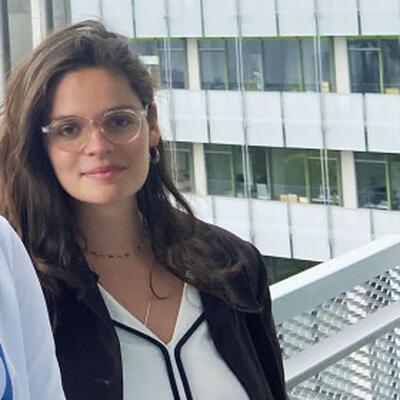
I am pleased to conclude my teacher-training program with a meaningful commitment that puts to good use the years of training I received at ENS Paris-Saclay.
Édith TURPYN is pursuing a DER in biology. In 2023, she is participating in the ASPEN (Année spécifique de parcours Engagement Normalien) program at the ARC Foundation (Association for Cancer Research) for 9 months.
A year dedicated to a personal engagement project
The “Engagement Normalien” Special Track Year (ASPEN) is a training year designed for Normalien students enrolled in the ENS Paris-Saclay diploma program. It is based on the development of a personal engagement project, approved by the School and carried out within a host organization.
"Since the beginning of my higher education, I have been drawn to community service, human interaction, and writing. During the 2021–2022 academic year, I was able to participate in a mentoring project at the École des Neuveries in Gif-sur-Yvette. Over the course of a month, we organized various sessions for CM1 and CM2 classes focused on science, specifically the microscopic world. There were many challenges. Creating content that was concrete and hands-on enough to engage the students, answering their questions in simple terms while avoiding the pitfall of oversimplification. At first, I was nervous about standing in front of about thirty pairs of curious eyes, but in the end, I absolutely loved this experience of science outreach.
That’s why, when I learned about this new requirement for earning the degree from ENS Paris-Saclay, I immediately saw it as an opportunity to pursue a path during my final year at the School that aligned with these personal interests."
Getting Involved with the ARC Foundation
With more than 460,000 new cases recorded and a standardized mortality rate of 123.72 per 100,000 in France in 2020, cancer is the leading cause of death, ahead of COVID-19. It is a major public health issue. According to figures from the National Cancer Institute (INCa) for 2022, an estimated 3.8 million people in France have or have had cancer. Added to this figure are the 5 million people who regularly support and/or care for someone affected by cancer. Across all age groups, of the 2 to 3 people out of every 100 in France living with cancer, nearly 60% will experience long-term effects (VICAN-5 survey, 2018, INCa).
“It is therefore essential to support cancer research, and that is the mission of the ARC Foundation (Association for Cancer Research).”
Established in 1962 as a nonprofit organization under the French Law of 1901, the ARC Foundation, based in Villejuif in the Val-de-Marne department, was recognized as a public-interest organization four years later, in 1966. Over the 61 years since its founding, the ARC Foundation has sought to fulfill two main commitments thanks to the donations and bequests it receives:
- Mission No. 1: to fund cancer research (awards, grants, etc.) with the goal of curing two out of every three cancers by 2025;
- Mission No. 2: to communicate, inform, and make cancer research accessible to the general public (articles, flyers, podcasts, etc.).
Making cancer research accessible to the general public
“It is in support of this second mission that I will be joining the ARC Foundation for nine months. I will be entrusted with several responsibilities, including distributing existing communication materials throughout the region, writing science communication articles on the latest developments in cancer research, and developing innovative communication materials for both the medical community and the general public."
The ARC Foundation’s mission of science communication and outreach to the general public has four main objectives:
- Encouraging preventive behaviors among the population: To date, nearly 40% of cancers are attributable to environmental factors and risky behaviors (INCa). This is particularly true of smoking, which is responsible for more than 8 out of 10 lung cancers (Hansen et al., 2020);
- To instill a sense of hope in patients and their loved ones and encourage participation in clinical trials;
- Raise more funds to finance research;
- Train medical staff to provide better patient care.
Develop skills that will be useful for the rest of my professional career
"This year of exploration will allow me to fulfill a commitment that is close to my heart while developing skills that will be useful for the rest of my professional career, such as:
- communicating complex ideas in accessible terms,
- synthesis and writing skills,
- gaining a comprehensive overview of current cancer research,
- a better understanding of how private funding is allocated for research, and building a professional network in the field of oncology."