 Initial Training
 2 years of post-secondary education (L2 or equivalent)
 French and English
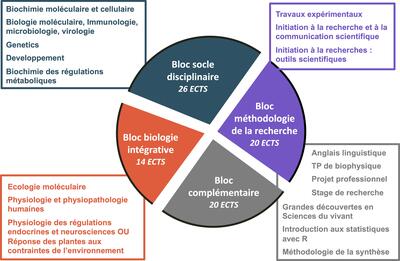
The first year of the ENS Paris-Saclay degree in Biology is part of the LDD3 program in Chemistry, Life Sciences, or Mathematics, Life Sciences, Biology track at Paris-Saclay University and corresponds to an enhanced third year of a bachelor’s degree (L3), i.e., equivalent to 80 ECTS credits.
Its goal is to gradually transition students from a general education to a university-level education that is fully open to the world of scientific research and requires a greater degree of independence.
Acquire a foundation of theoretical and practical knowledge in numerous disciplinary fields of biology.
Within the Department of Biology Education and Research (DER), students at the École Normale Suprême (ENS) take high-level theoretical courses in the form of lectures and tutorials.
This program is supplemented by numerous practical sessions, particularly in the first semester, to familiarize students with techniques commonly used in the laboratory. These lab sessions are structured around a research problem and typically take place over an entire week.
- Acquiring scientific tools:
During this first year, students acquire the essential tools for their future scientific careers: fundamentals of biostatistics and bioinformatics, linguistic and scientific English, reading and analyzing scientific articles, and scientific communication.
They also strengthen skills essential to any scientist, such as rigor, analytical skills, the ability to present arguments, and the ability to synthesize information.
Exploring careers in teaching and research:
Through laboratory visits, research internships, and career guidance roundtables, students are introduced to the world of research and higher education.
The program is designed to prepare ENS students to pursue a master’s degree (since the program at ENS Paris-Saclay spans four years) through the M1 in Biology at the University of Paris-Saclay/ENS Paris-Saclay, with specializations in Neuroscience, Microbiology, and Molecular and Cellular Biology.
The students from the École Normale Supérieure who enroll in the program have diverse backgrounds. Some are admitted through competitive exams, while others are admitted based on their application materials; they come from preparatory classes or various university tracks (second-year bachelor’s degree, dual-degree second-year bachelor’s program, etc.).
To be admitted to the program, you must have a solid foundation in general biology (equivalent to the second year of a bachelor’s degree or completion of the BCPST or TB preparatory class) and a strong interest in research, experimentation, and biology at the microscopic level.
Academic partner(s) for the program
Bachelor’s Degree in Biology and Health and Master’s Degree in Biology from Paris-Saclay University
School of Cancer Sciences, Gustave Roussy Institute