
The Master 2 program in “Higher Education Teacher Training” (M2 FESup) is certainly a teacher-training program, but in addition to raising students’ awareness of the importance of knowledge transfer, it also develops analytical skills, organizational abilities, and oral communication skills—qualities that are equally essential in other fields, such as research. Whether I choose to pursue a career exclusively in teaching or one more focused on research, this year of preparation for the agrégation exam will be very useful to me.
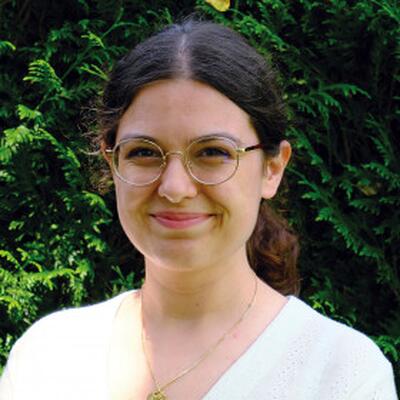
Julie Pauliat from the Department of Biology Education and Research ranked first in the 2024 “Biochemistry and Biological Engineering” agrégation exam.
Profile
What is your educational background?
I’m from Limoges, where I attended school through high school. In 2019, I earned a scientific baccalaureate (S-SVT) with a specialization in mathematics at Auguste Renoir High School. I then enrolled in the BCPST (Biology, Chemistry, Physics, and Earth Sciences) preparatory class at Henri IV High School in Paris.
In 2021, I enrolled at ENS Paris-Saclay in the Department of Teaching and Research (DER) in Biology, entering the 1A program (equivalent to the third year of a bachelor’s degree) through the student admission track (based on application materials). At the end of my 1A year, I took and passed the second competitive exam, an admission pathway to enter ENS Paris-Saclay in the second year, which is also open to current ENS students.
At ENS Paris-Saclay, my academic path has been quite traditional: a Bachelor’s degree (L3) in biology, with the first semester taking place within the DER and the second semester largely at the Orsay Faculty of Sciences, followed by a Master’s 1 (M1) in Biology and Health from Paris-Saclay University. There, students choose their course units (UE), some of which are offered by ENS Paris-Saclay.
This year, I took the preparatory course for the BGB agrégation as part of the M2FESup program at ENS Paris-Saclay.
Did you know from the start what you wanted to do when you entered ENS Paris-Saclay?
Ever since high school, I’ve wanted to pursue a career in research and teaching. When I applied to ENS Paris-Saclay, I was already considering taking the agrégation exam, but other specialized track options for that year seemed just as interesting to me.
I then decided fairly quickly to focus on preparing for the agrégation, which satisfied both my intellectual and professional interests.
Why did you choose a Master’s in Higher Education Teaching (FESUP)?
I was, of course, interested in teaching, but above all, I saw it as a unique opportunity to deepen or acquire a wide range of knowledge in biology before specializing in a Master’s 2 in Research (M2R).
During my third year of undergraduate studies (L3) and first year of my master’s program (M1), I found the courses offered by the Biology DER program at ENS Paris-Saclay to be extraordinary. Having the opportunity to complete a preparatory year at ENS Paris-Saclay was therefore also a motivating factor. The program’s setting is also exceptionally favorable, with small classes (around ten students) and a dedicated and attentive faculty.
The Master’s 2 program in “Training for Higher Education” (M2 FESup) is certainly a teacher-training program, but in addition to raising awareness of the importance of knowledge transfer, it also develops analytical skills, organizational abilities, and oral communication skills—qualities that are equally essential in other fields, such as research. Whether I later choose to pursue a career exclusively in teaching or one more focused on research, this year of preparation for the agrégation exam will be very useful to me.
What does the “Biochemistry and Biological Engineering” program entail?
The “Biochemistry and Biological Engineering” (BGB) agrégation is a competitive exam for recruiting technology teachers: in secondary school for the STL or ST2S tracks, and in higher education for CPGE TB, BTS, IUT, or university programs.
More specifically, the BGB Agrégation program is divided into three main areas: biochemistry, cell biology and physiology, and microbiology.
The program therefore focuses on biology at the molecular, cellular, and organismal levels, with a particular emphasis on health and biotechnology.
Chemistry is also studied, both theoretically and practically, with a curriculum that more or less corresponds to that of the BCPST program.
In each of these areas, the courses cover the most up-to-date fundamental knowledge, supported by experimental aspects—whether historical or contemporary. Physiopathological and biotechnological aspects are also explored. This program is particularly interesting because, beyond teaching, the theoretical knowledge and biotechnological skills can be applied to research, for example.
What are your plans for the future? Do you have any career plans?
In 2024/2025, I will continue and complete my studies at ENS Paris-Saclay, pursuing a Master 2 research degree in genetics from Université Paris-Cité.
I would then like to write a dissertation in the field of epigenetics and development. What comes next will depend on my experience as a doctoral student. I’ve loved my research experiences during my internships, but I don’t yet have enough perspective to make a definitive choice between taking a teaching position or continuing in research while maintaining a teaching role.
Can you tell us what the School has offered you?
When I enrolled at ENS Paris-Saclay, I was able to benefit from an exceptionally privileged academic environment. The school is housed in new facilities, and significant resources are made available to us, particularly for lab work in the DER in Biology.
We’re also fortunate to be in small classes, which creates a more friendly atmosphere. The faculty in the Biology DER program is extremely dedicated and attentive. I found the courses they offer to be of exceptional quality, and they instilled in me the high standards and rigor required of any scientist.
Being an ENS student also offers many advantages, such as when searching for internships, as well as the possibility of thesis funding, for example.
Finally, it was thanks to ENS Paris-Saclay that I was able to take a year off to prepare for the agrégation, with the assurance that I could continue my studies afterward. My four years at the school allowed me to gain exposure to various disciplines, take the time to explore different aspects of the professional world, and make a career choice based on my experiences.
What would you like to say to students who are hesitant about coming to ENS Paris-Saclay?
I certainly hope that my answer to the previous question has convinced them to join ENS Paris-Saclay. For those who are still hesitating, I’ve certainly talked a lot about teaching and research—areas in which ENS Paris-Saclay will train you thoroughly—but these are by no means the only aspects of the education offered at ENS Paris-Saclay.
During your studies at ENS Paris-Saclay, at least one year is devoted to a project of your choosing—whether it’s preparing for the agrégation, a year of research abroad, the chance to explore other disciplines, another school, or a path more deeply engaged with today’s major societal and scientific challenges. This choice extends to your career as well: the School opens many doors, whether in the public or private sector. Finally, as an ENS graduate, you’ll have the opportunity to put the excellent education you’ve received to work for the greater good.