
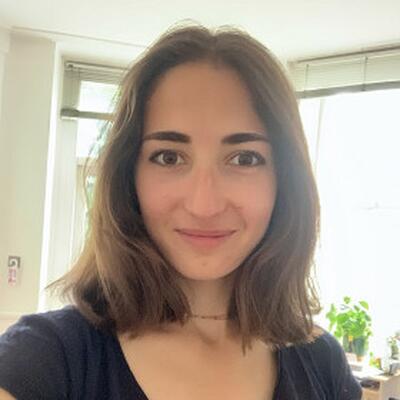
Because I have a particular interest in drawing and sharing knowledge, I chose to dedicate myself—as part of a special year of service at the École Normale Supérieure (ASPEN)—to disseminating knowledge in medical biology using comic books as a communication tool.
In 2024, Margot Del-Valle--Lezier is a third-year student in the Department of Teaching and Research (DER) in Biology at the École normale supérieure de Paris-Saclay.
She hopes to specialize in immunology with the goal of eventually pursuing a Ph.D. and working as a researcher on the interactions between the immune system and our microbiota—the collection of microorganisms living on the surfaces of our bodies—in the treatment of chronic inflammatory diseases or cancer.
She chose the ASPEN (Année Spécifique d’Engagement Normalien) program to develop a comic book project titled “Better Understanding Health Through Comics” in collaboration with INSERM.
“With a particular interest in drawing and sharing knowledge, I chose to dedicate myself, as part of a specific year of engagement at the École Normale Supérieure (ASPEN), to disseminating knowledge in medical biology using comics as a communication tool.”
A commitment driven by a passion for education
“Alongside her studies, I had the opportunity to serve as an examiner for CPGE entrance exams, a private tutor for children struggling academically, and a teacher at the Institut Louis Germain, an organization that runs pre-school-year camps to help young people from REP+ areas gain admission to the grandes écoles.”
Together with Eva Bosset, a classmate and friend from the Biology DER program, she recently created a comic book for the ASSEDEA association to explain to children with transverse limb agenesis the causes of their condition.
“Through these enriching experiences, I’ve come to understand just how much I’m driven by providing explanations and helping others understand abstract or technical concepts—especially by using vivid comparisons. In other words, I love it when that little spark lights up in their eyes.”
A Commitment to Science Communication in Medical Biology
According to the survey “The French and Health Prevention” conducted by the firm Elabe<, the PiLeJe Foundation, and the Pasteur Institute of Lille/, health has become the top concern for the French (37%) since the first COVID-19 pandemic, ahead of the terrorist threat (33%) and the environment (28%).
Furthermore, a new study titled “Information and Health,” published by the Descartes Foundation in late November 2023, reveals that French people who seek information on medical topics via social media, YouTube, or instant messaging groups have “a lower level of health knowledge than others” due to the greater presence of “false, misleading, or questionable health information.”
Consequently, the ability to understand what a doctor says and to participate in public health debates is severely challenged, and certain fundamental knowledge is too often unclear, vague, or even a complete mystery.
“The obstacle is even greater when it comes to the most recent discoveries and techniques. Yet this affects everyone, and many laypeople express curiosity about these topics on a daily basis. After all, we’re talking about how our own bodies function—or fail to function!”
“I decided to get involved to help people without medical training feel more engaged with ethical issues and to encourage their participation in the public health debate. It is therefore essential to ensure access to verified and transparent scientific information, presented unambiguously through popular science that, despite the simplification of concepts it entails, does not compromise on rigor or accuracy. The goal is to do my part to combat misinformation and the threat of conspiracy theories that arise from it, as was the case during the most recent pandemic, COVID-19.»
Sparking Curiosity Through Comics
«I’ve been drawing regularly since I was very young and have always had this irrepressible desire to “create.” By choosing this medium, my goal is to spark curiosity—and even a sense of wonder—in readers, who will thus be immersed in an exploration of the lush ecosystems that unfold at the cellular level. Just as the conquest of space and the infinitely large inspire fascination, I hope that such a journey into the infinitely small—or nearly so—will spark an interest in science among the youngest readers.»
A project carried out in collaboration with the French National Institute of Health and Medical Research
(Inserm)
Margot is working on this project with the Information, Communication, and Scientific Culture of Inserm’s Grand Ouest Regional Office, the leading state-funded research institute 100% dedicated to biology and health research. “In recent years, this regional office has become familiar with comics as a form of outreach.”
Her project aims to make a set of fundamental knowledge and concepts regarding everyone’s health accessible to the general public: our immune systems, infectious and emerging diseases, various types of cancer, antibiotic resistance, allergies, and our microbiomes—all woven into a fictional story in which the various cellular and molecular landscapes and components that make up our bodies will be depicted graphically. “This will be presented in a simplified, even humorous way; however, the content of the illustrations will aim to be faithful to reality. I also hope to use this opportunity to inform readers about preventive measures, commonly used treatments, and the latest therapeutic advances—which sometimes spark debate.”
A weekly series will be available on social media, particularly Instagram, to provide engaging updates on various news stories stemming from recent research and discoveries by INSERM scientists.
A project to advance my future career
“This project will allow me to acquire skills that will be useful in the long term for my professional career. In fact, above all, this is an unprecedented opportunity that will allow me to acquire skills that are useful—and even necessary—for my future profession. Furthermore, it will be a unique chance to build experience and credibility in the field of science communication, which I do not rule out joining later.”
- To work independently by exploring comics as a tool for communicating news, taking the initiative when creating panels, and interviewing researchers about their work.
- Gain a broad, interdisciplinary perspective on knowledge across various fields of biomedical research by popularizing the work of diverse teams.
- Practice conducting research and synthesizing the literature, which is a major asset for better understanding this essential component of a Ph.D. and the profession of researcher as well as science communicator.
- To enrich my foundation of knowledge in human microbiology—the field in which I plan to pursue my future career as a researcher—by reading scientific publications in this discipline while creating the comic strips.
- Taking on more responsibility, whether in administrative tasks or work organization.
- Making decisions as part of a team through discussions with various professionals at Inserm.