You’ll have access to high-quality instruction and a wide range of hands-on projects; you’ll be able to gain experience in both teaching and research, with the opportunity to complete several internships, particularly abroad. All of this combined will ultimately help you develop a very interesting multidisciplinary profile!
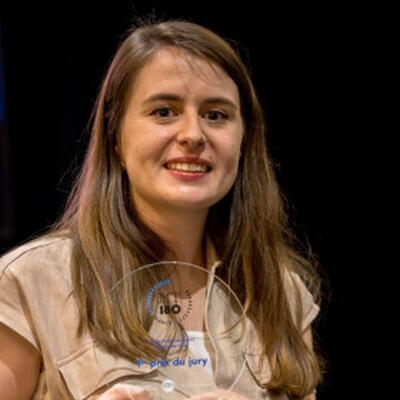
Wendy LE MOUËLLIC, a graduate of the DER in Biology (class of 2019) and a doctoral student at the University of Toulouse’s Institute of Pharmacology and Structural Biology, won the 2024 final of “My Thesis in 180 Seconds.”
What is your educational background?
After two years in the BCPST preparatory program at Lycée Jean-Baptiste Say (Paris), I was admitted to ENS Paris-Saclay in 2016 through a competitive entrance exam.
There, I completed my L3 and M1 degrees, followed by a preparatory year for the Biochemistry and Biological Engineering agrégation, and finally my M2 in Fundamental Bacteriology at the University of Paris – Institut Pasteur.
In 2018, I completed the preparatory year for the Biochemistry and Biological Engineering agrégation, which I passed. I learned about this program through the biology department, which introduced us to all possible career paths as soon as we entered ENS Paris-Saclay, so that each of us could build the academic path that best suited us. It is a year of intensive preparation for the agrégation exam (written exams followed by oral exams and practical work). We attend a large number of courses taught directly at ENS Paris-Saclay (in the case of this certification in particular), in an ideal setting since class sizes are generally small. The curriculum combines chemistry, biochemistry, molecular and cellular biology, physiology, microbiology, and immunology…
For me, this is the year when we take a step back to reflect on a number of concepts and make connections between the different fields. Beyond simply qualifying for the agrégation exam, this year offers us so much in terms of teaching skills and knowledge. Even several years later, when I’m supervising lab sessions or tutorials, knowledge I acquired during that year suddenly comes back to me—even when I thought I’d forgotten it!
I graduated from ENS Paris-Saclay in 2020, and then, thanks to a special doctoral contract for ENS graduates, I continued my doctoral research in Toulouse at the lab where I had completed my Master’s 2 (M2) internship.
Did you know what you wanted to do when you entered ENS Paris-Saclay?
Not really. I took the ENS entrance exam after a researcher from the Pasteur Institute came to our preparatory class to introduce us to his work. That’s when I realized that I, too, wanted to understand, dissect the mechanisms, and seek answers—and the ENS was the best school for that.
Did you want to pursue research from the very beginning of your studies?
Like many others, I think I wavered for a long time between research and teaching during my years at ENS Paris-Saclay.
I opted for the “teaching track” with the year of preparation for the agrégation, but I returned to research with my dissertation. Even today, I feel I’m straddling both fields, but one doesn’t preclude the other!
Can you tell us what the School provided you during your four years of graduate study?
I think that during our four years at ENS Paris-Saclay, we develop a solid work ethic, critical thinking skills, and written and oral communication skills (particularly through the year of preparation for the agrégation, but not exclusively). You don’t necessarily realize it at the time, but you do in hindsight, and these skills can be useful in many fields, not just teaching and research.
Can you summarize your dissertation in a few sentences?
During my dissertation, Characterization of the pathways for sulfur acquisition and cysteine biosynthesis in Mycobacterium tuberculosis during infection, I focused on sulfur acquisition by the bacterium M. tuberculosis, which causes tuberculosis. In other words, I sought to understand which sulfur-containing molecules could actually be utilized by this pathogen within macrophages and in the lungs of infected mice, and how they were subsequently used to produce cysteine, a key molecule in sulfur metabolism.
I also studied the role of this sulfur metabolism in the response to various stresses that M. tuberculosis may encounter during infection.
Your dissertation is funded by a specific École Normale Supérieure doctoral contract (CDSN). What does this entail?
The École Normale Supérieure-Specific Doctoral Contract is a three-year doctoral contract open to École Normale Supérieure students, whether they were admitted to ENS Paris-Saclay based on their application materials or through a competitive exam.
To apply, you must submit an application package, which includes a detailed scientific proposal for your future dissertation. If you are accepted, you will be affiliated with the doctoral school corresponding to your laboratory but with your own funding.
The doctoral school may sometimes require you to take an oral exam after you’ve been awarded the CDSN. This type of contract is a real asset—first, for applying to research teams by bringing your own funding, but also as a first experience in writing a grant proposal.
What stands out most to you about ENS Paris-Saclay?
I think it’s the diversity of academic paths. I’ve seen a wide range of situations across the different cohorts, which, incidentally, end up mixing as the duration of their respective programs varies. I’ve seen friends enter ENS Paris-Saclay having already decided to take the agrégation exam to become teachers, only to find their true calling in basic research; while others, on the contrary, returned to teaching after a Ph.D.; some of the most courageous decided to pursue medical school in addition to their ENS Paris-Saclay program; and there were even more unconventional paths, such as dual degrees at engineering schools.
What advice would you give to young students preparing for the ENS Paris-Saclay entrance exams, or to those who are hesitant about applying through the competitive exam or by application?
If you enjoy gaining a deep understanding of biological mechanisms—from biochemistry to physiology, and even at the ecosystem level in certain master’s programs—I think ENS Paris-Saclay is truly the place for you!
You’ll have access to high-quality instruction and a wide range of lab work; you’ll be able to engage in both teaching and research, with the opportunity to complete several internships, particularly abroad. All of this combined will ultimately help you build a very interesting multidisciplinary profile!